Main Street Veterinary Service
Who can I contact about declaw repair surgery for house-cats?
Dr. Gaskin posts info, videos & a PowerPoint presentation online for vets who want to know more about this surgery that may provide some relief for declawed cats.
http://www.msvets.com/Our%20Staff.html
DECLAW REPAIR
Main Street Veterinary is a full service veterinary practice in Shakopee, MN specializing in small animal health care for cats and dogs. Our mission is to provide the highest quality in veterinary medical animal pet health care in a professional, friendly, relaxed environment.
www.msvets.com
DECLAW SALVAGE SURGERY
Dr. Gaskin posts info, videos & a PowerPoint presentation online for vets who want to know more about this surgery that may provide some relief for declawed cats.
http://www.msvets.com/DeclawRepair.html
INDICATIONS FOR A DECLAW PAW SALVAGE SURGERY
· Holding either paw up.
· Calluses on the front of digit pads especially digits 3 and 4.
· Very reluctant to have digits straightened or even touched.
· Radiographs show distal P2 cartilage damage or P3 fragments.
· Tight muscle knots in lumbar muscles.
· Excessive biting
· Inappropriate elimination with no other identifiable cause.
Acknowledgements
I want to thank Letrisa Miller MS DVM for her invaluable input and for sharing her astute observations of the declawed cat's problems.
"I looked but I did not see, she illuminated then I did see."
Reference
Bilateral flexor tendon contracture following onychectomy in 2 cats
Maureen A. Cooper, Peter H. Laverty, and Emily E. Soiderer Can Vet J. 2005 March; 46(3): 244–246
Indications for Declaw salvage surgery
MEET RAVEN:
OUR DECLAW POSTER CAT
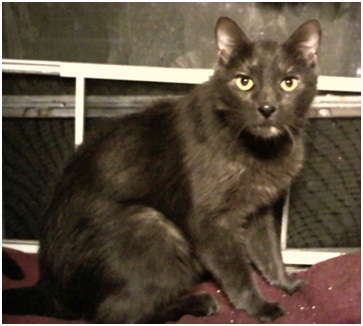
Raven - a rescue cat nobody wanted to keep. Antisocial, would bite you when she was hungry, attacked other cats, did not run or play. 7 years old at the time of the declaw salvage surgery. Now lives in a single cat home where she can run and play again. She still bites when she gets scared but is much better with humans.
WHY THE SURGERY?
These radiographs (x-rays) were acquired using an oblique dorsal-palmar angle. A digital dental sensor was used because of its high resolution and speed.
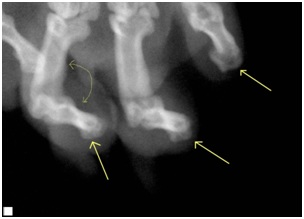
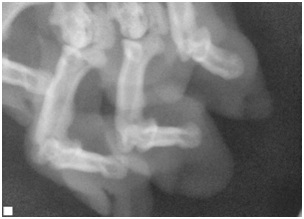
Arrows indicate pathology to distal P2 cartilage. Radius shows acute angle of formed by hyperflexion of P1 and P2. Raven is walking on her amputated toes.
Radiographs of declawed cat paws
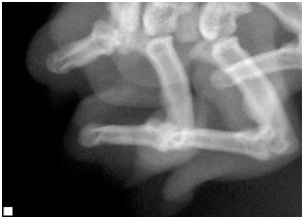
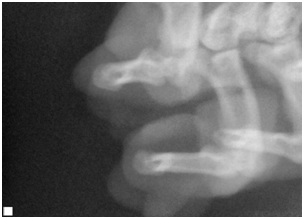
RAVEN’S PAW RADIOGRAPHS
Surgery indication for Raven
Please wait for the video to download. Front digit pad calluses can be seen in this video. The very taunt flex tendons are demonstrated also.
SUCCESSFUL COUTCOME FOR RAVEN!
Surgery done for Raven.
Raven was walking very well after the surgery and continues to improve daily.
We are finding Raven a new home away from other cats.
A DECLAW REPAIR STORY:
This cat was declawed as a kitten and then 8 yrs later disposed of when his owner was moving - she took her other cats & dog but dumped this cat at a vet’s office.
Why?
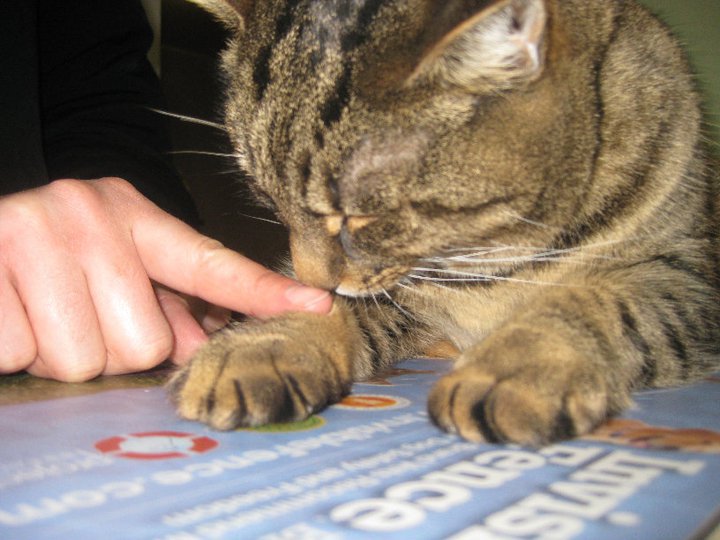
Because he had several issues - all related to his declawed paws - which included crying incessantly, chronic UTI's (which can be stress related), flicked and shook his paws in the air, and he didn't use the litterbox.
This cat was immediately put on Prozac and joint support treatment by the vet and a few weeks later had a tendonectomy performed to release his flexor tendons that had become stiff - the flexor tendons retract and stiffen after they are sliced or burned off during declaw surgery and cause the joints that they once helped to move to "freeze", which is very painful.
"In declawed (and tendonectomized) cats, the tendons that control the toe joints retract after surgery, and these joints become essentially “frozen.” The toes remain fully contracted for the life of the cat. In cats that were declawed many years ago, the toe joints are often so arthritic that they cannot be moved, even under deep anesthesia. The fact that most cats continue to make scratching motions after they are declawed is often said to “prove” that they do not “miss” their claws. However, this behavior is equally well–and more realistically–explained as desperate but ineffective efforts to stretch those stiff toes, legs, shoulders, and backs.” Dr. Jean Hofve
http://www.littlebigcat.com/health/declawing-a-rational-look/
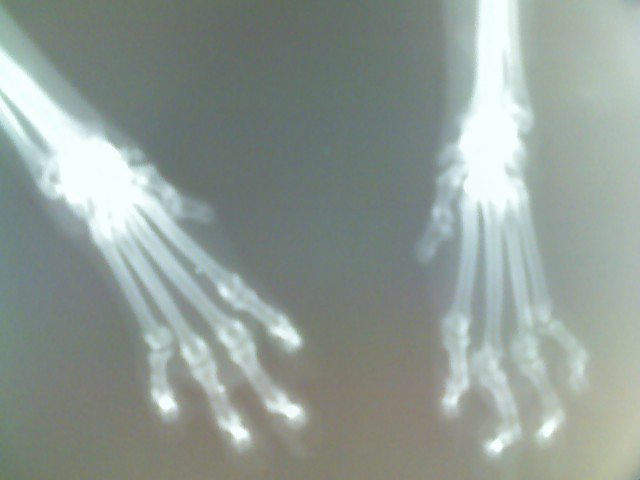
These are radiographs of his declawed paws before surgery. The inflammation at the toe ends and stiff joints look very similar to a human with rheumatoid arthritis.
"...the foamy look on the end of phalange 2 on digits 2 & 3 (major weight bearing digits). This foamy look is chronic damage to the cartilage & bone end from walking on the amputated toe tips."
http://www.pictures-of-cats.org/
dr-ron-gaskin-is-a-good-vet-who-
performs-declaw-repair-surgeries.html
"These problems are compounded by the chronic pain that many de-clawed cats suffer, and show lameness and abnormal vertebral and postural misalignments due to paw-pad pain from abnormal weight distribution on certain pads, and also from chronic inflammation, post-surgical infection, chronic arthritis and osteomyelitis, and contractions of the flexor tendons." http://www.twobitdog.com/
DrFox/specialreport_Article.aspx?
ID=46b4b2c4-93d6-4582-b4ec-7d311782aab8
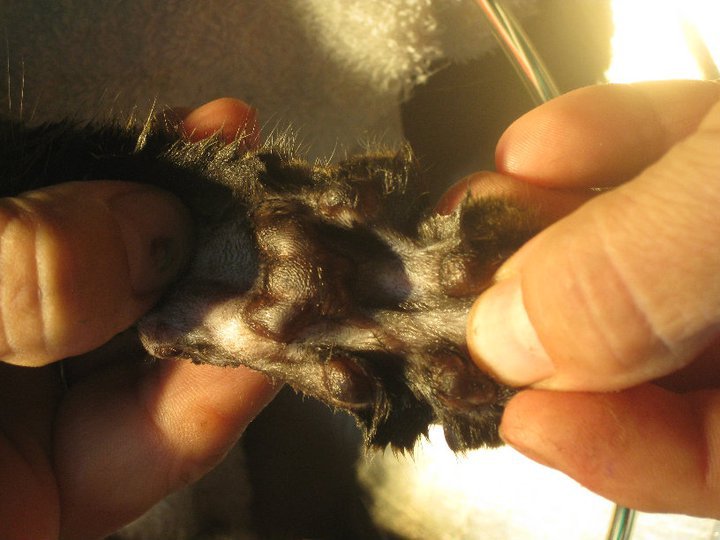
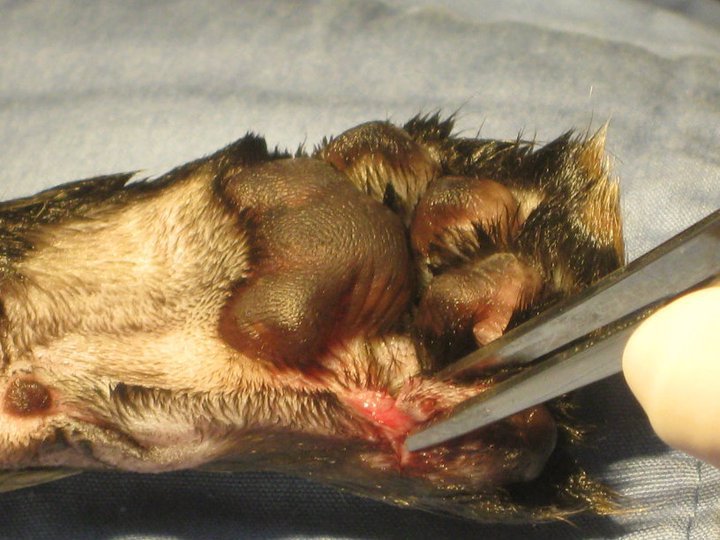
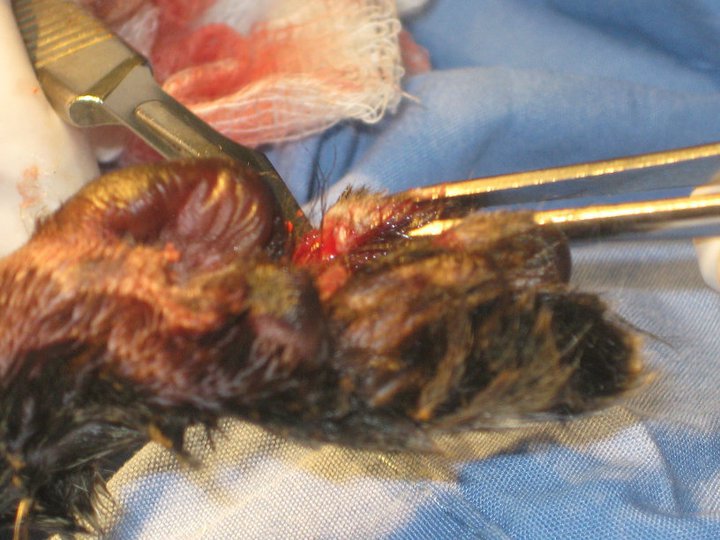
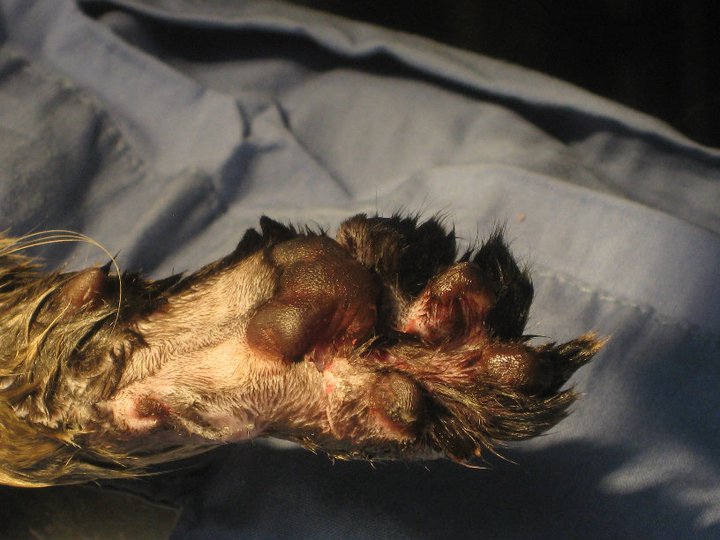
A tendonectomy is being performed to release the frozen tendons in his front paws many years after his initial 'declaw' surgery. You can see how tight (look like "tents") his other toes are in comparison to the one that has been released.
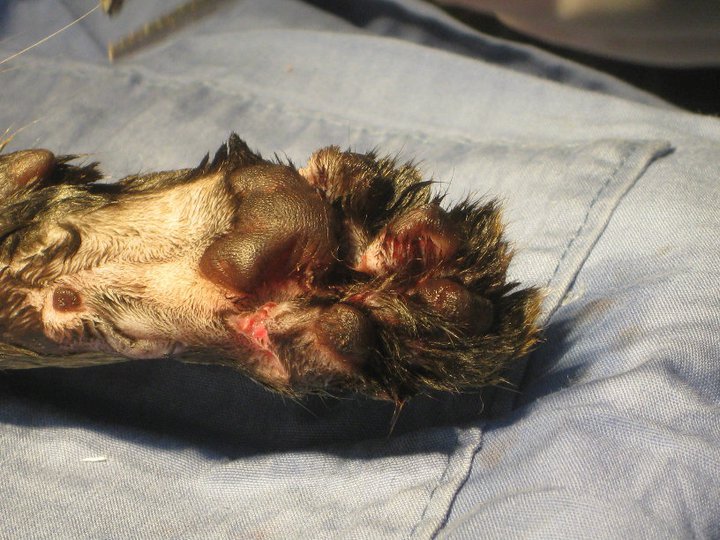
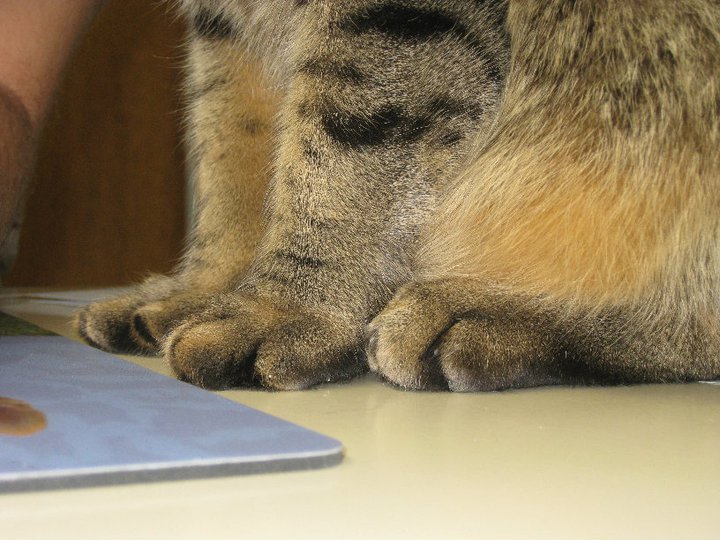
Post surgery, his stiff "tented" looking tendons have been released and he walks flat footed now.
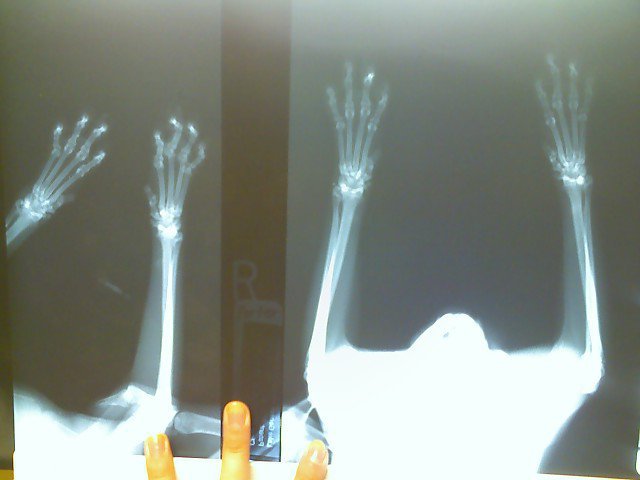
Radiographs of pre-op (left) and post-op (right) of the repair surgery - his stiff tendons are flat after being released and there is much less inflammation. After surgery he was weaned off Prozac, his incessant crying has stopped, and he has had no more UTI's. He still occasionally flicks his hands but he is much more comfortable considering the chronic pain he lived with needlessly for the first half of his life. He is still on Glycoflex (joint support) and Composure (emotional support).
Some GOOD news... a little kitten at the vet office fell in love with this cat, and 2 days after she was adopted, the family came back for him, (no one wanted to adopt him because he needed daily pain meds)
They are now living happily ever after! J