BEHAVIORIAL CHANGES
Doctors know that human amputees “feel” the missing limb, even long after the amputation. Cats are very similar to humans in most physical ways. Changes in the declawed cat’s behavior are a fantastic indicator that the cat is feeling the same things as all other amputees feel: Phantom sensations from the missing parts.
**********
"We may not know when some cats are suffering because of their stoic nature, and the fact that some cats in great discomfort may actually purr and seem to be half-asleep. Such self-comforting, so-called displacement behaviors are indicators of stress. Cats may learn to cope with the chronic pain of onychectomy, but the absence of overt pain does not mean they are pain-free." Dr. Michael W. Fox, D.Sc., Ph.D., B. Vet. Med., M.R.C.V.S.

**********
In a study published in the January, 2001 JAVMA, 33% of 39 (1 in 3) cats that underwent onychectomy (declawing) developed "at least" one behavior problem immediately after surgery, with the most common problems being litter box problems and biting.
**********
"A declawed cat is anatomically and mentally damaged. Careful observation of clawed vs. declawed cats on entry to the vet’s office reveals a cat’s amazing ability to remember. They can and do associate cause and effect. This is a hallmark of a thinking sentient creature."
Ron Gaskin DVM
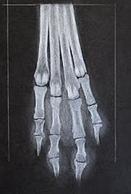
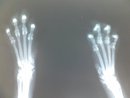
On the left is an x-ray of a normal cat's front paw. Notice how the fingers are extended and relaxed. On the right is an x-ray of a declawed cat's front paws. Notice the deformed finger ends.
This declawed cat is a 3 year old male who had his hands de-fingered 2.5 years ago at age 6 months. He has had chronic Urinary Tract Infections for the last 1.5 years (UTI's can be stress induced), is aggressive, inactive, and overweight.
**********
"Virtually all human amputees report “phantom” sensations from the amputated part, ranging from merely strange to extremely painful (about 40% of such sensations are categorized as painful). Because declawing involves at least ten separate amputations, it is virtually certain that all declawed cats experience phantom pain in one or more toes. In humans, these sensations continue for life, even when the amputation took place in early childhood. There is no physiological reason that this would not be true for cats; their nervous systems are identical to ours. Cats are stoic creatures, and typically conceal pain or illness until it becomes overwhelming. With chronic pain, they simply learn to cope with it. Their behavior may appear “normal,” but a lack of overt signs of pain does not mean that they are pain-free".
Dr Jean Hofve, DVM
http://www.littlebigcat.com/
health/declawing-a-rational-look/
**********
"In declawed (and tendonectomized) cats, the tendons that control the toe joints retract after surgery, and these joints become essentially “frozen.” The toes remain fully contracted for the life of the cat. In cats that were declawed many years ago, the toe joints are often so arthritic that they cannot be moved, even under deep anesthesia. The fact that most cats continue to make scratching motions after they are declawed is often said to “prove” that they do not “miss” their claws. However, this behavior is equally well–and more realistically–explained as desperate but ineffective efforts to stretch those stiff toes, legs, shoulders, and backs.” Dr. Jean Hofve
http://www.littlebigcat.com/
health/declawing-a-rational-look/
**********
Since 1966 there have been only six articles in the US veterinary literature, including one by a Canadian veterinarian, which examined the behavioral effects of declawing.
The first (Bennett, et al.), looked at only 25 declawed cats, but reported that declawed cats were 18.5% more likely than non-declawed cat to bite and 15.6% more likely to avoid the litter box
Morgan and Houpt found that the 24 declawed cats in their internet survey had a 40% higher incidence of house soiling than non-declawed cats.
**********
Based upon conversations with our customers who bought Feliway because their cats were peeing outside of the box I'd say that at least 60%, if not closer to 70%, of these people had cats that were declawed...” Cat Faeries behaviorist and feline territory specialist
**********
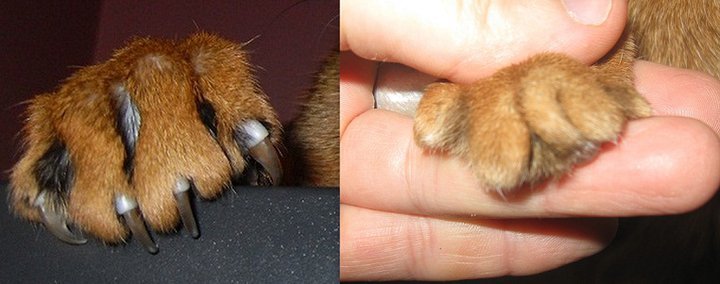
DE-CLAWED PAWS are de-formed paws, disfigured paws, dismembered paws, destroyed paws that are prone to a lifetime of pain & discomfort. The normal paw is on the left, and the declawed paw is on the right. Notice the deformed shape of the declawed toes.
**********
In a study published in the January, 2001 JAVMA, 33% of 39 (1 in 3) cats that underwent onychectomy developed "at least" one behavior problem immediately after surgery, with the most common problems being litter box problems and biting.
..."declawed cats are more likely to be relinquished than normal cats...Unwanted behavior is a major factor in relinquishment of cats to shelters. House-soiling, aggression, and biting are the top 3 reasons why cats are surrendered; as noted, these are the very same problems that 1 in 3 declawed cats will develop after surgery.” Dr. Jean Hofve, DVM
http://www.littlebigcat.com/
health/declawing-and-science/
**********
Published 2/1/03 on CourierPostOnline.com, "Eighty percent of the cats that are surrendered that are declawed are euthanized because they have a behavioral problem…. Declawed cats frequently become biters and also stop using litter boxes… One or the other…,” said William Lombardi shelter director, Gloucester County, New Jersey.
**********
Gloucester County Animal Shelter, says Lombardi, who’s been the director for three years and an animal control officer for 25, Cats with claws, he says, are always surrendered for human-related issues, mainly “moving and can’t take the cat with us.” Declawed cats, on the other hand, have behavior problems, and most that come in end up having to be euthanized. Even when Lombardi works with declawed cats and tries to place them in new homes, they often come back to the shelter for not using the litter box”.…”Almost all of our hotline calls are declawed cats with litter box issues,” says Pat Rock of the Oshkosh Area Humane Society in Wisconsin.” “ The Declaw Dilemma", Nancy Lawson
http://www.animalsheltering.org/
resource_library/magazine_articles/
may_jun_2004/declaw_dilemma.pdf
**********
“Chronic physical ailments such as cystitis or skin disorders can be manifestations of a declawed cat’s frustration and stress.” David E. Hartnett, DVM
http://www.petstation.com/declaw.html
**********
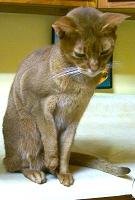
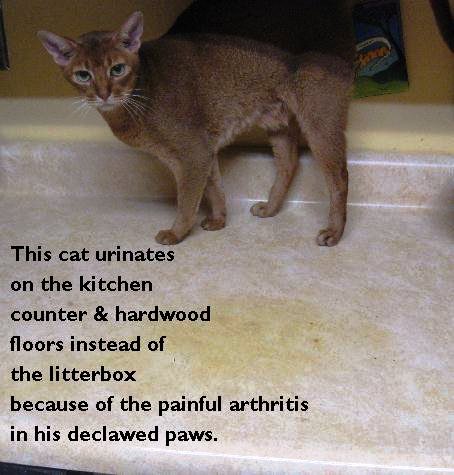
"This declawed Abyssinian cat (left) shows 4 distinct signs of pain: (1) half-closed eyes, (2) pulled-back whiskers, (3) holding the right front foot up, and (4) placing the left front foot over the edge of the counter so there’s as little weight on his painful toes as possible."
http://www.littlebigcat.com/
health/declawing-a-rational-look/
**********
Seventy percent (70%) of cats turned in to pounds and shelters for behavioral problems are declawed. (National Survey from pounds & shelters obtained by Caddo Parrish Forgotten Felines & Friends)
http://www.sniksnak.com/
cathealth/declaw.html
**********
From the Summer 2002 issue of PETA’s Animal Times: “A survey by a Delaware animal shelter showed that more than 75% of the cats turned in for avoiding their litter boxes had been declawed.
**********
In my own three-year experience, 95% of calls about declawed cats related to litter box problems, while only 46% of clawed cats had such problems—and most of those were older cats with physical ailments. Of my calls, only declawed cats have cost their owners security deposits, leather sofas and floorboards. And it’s mostly declawed cats that have been prescribed pain killers, anti-depressants, tranquilizers, and steroids. Two-thirds of my calls are about litter box problems. In 90% of those cases, the cat is declawed, sick, or old. In 7 years, only 3 people have called about a “scratching-the-sofa problem” - yet countless of “healthy” declawed cats have peed on sofas.” Annie Bruce, cat consultant & author Cat Be Good
www.goodcatswearblack.com
**********
“Asthma and cystitis (inflammation of the bladder) have also been linked to the stress of declaws…consider the possibility of post-surgery behavior problems – especially litterbox issues and aggression…reports abound among cat owners and some animal behaviorists also notice a link. Karen Overall, VMD, PhD, a specialist in veterinary medicine, has seen transient aggression and reluctance to use the litterbox after declaw. There is also the issue of trust...Interestingly, the humane society workers have made these claims about declawed cats for years”. "Declaw Details", Dr. Brenda McClelland, DVM, Cat Fancy Magazine Jan 2006 p. 44-47
**********
"De-clawed cats tend to walk abnormally back on their heels rather than on their entire pads because of the chronic pain at the end of their severed fingers and toes. They often develop chronic arthritis and as the front toe pads shrink, chronic bone infections are common....The tendons that control the toe joints retract after surgery. These joints essentially become “frozen.” The toes remain fully contracted for the life of the cat. In order to keep weight off the tender amputated toes, cats shift their weight backward, the altered gait stressing the limbs and spine, which could lead to arthritis later in life.”
Dr. Michael Fox
http://www.twobitdog.com/
DrFox/specialreport_Article.aspx?
ID=46b4b2c4-93d6-4582-b4ec-7d311782aab8
**********
Another county facility automatically puts down or transfers out any declawed cat, because of the greater likelihood that such cats will exhibit behavior problems such as litterbox avoidance or a propensity for biting.
http://www.bestfriends.org/
archives/forums/080105adoptions.pdf
**********
Declawing does not keep a cat in its home. A declawed cat may lose its home, because of behavior problems that may develop after declawing...Considering all factors in aggregate, statistically, a declawed cat is more likely to be killed in the pound, because it was declawed.” Dr. Jennifer Conrad, DVM, The Paw Project
http://www.pawproject.com/
psa/facts_tips.asp
**********
“In some cases, when declawed cats use the litterbox after surgery, their feet are so tender they associate their new pain with the box... permanently, resulting in a life-long aversion to using the litter box. Other declawed cats that can no longer mark with their claws, they mark with urine instead resulting in inappropriate elimination problems, which in many cases, results in relinquishment of the cats to shelters and ultimately euthanasia. Many of the cats surrendered to shelters are surrendered because of behavioral problems which developed after the cats were declawed. Risk factors for relinquishment of cats to an animal shelter: "Among 218 cats relinquished to a shelter, more (52.4%) declawed cats than non-declawed cats (29.1%) were reported by owners to have inappropriate elimination problems.” Source: World Small Animal Veterinary Association – 2001
http://maxshouse.com/
facts_about_declawing.htm
**********
2/2007 "...Delaware Humane Association...Declawing also can lead to litter box problems...75 percent of declawed cats in shelters are there because they had issues using their litter boxes.
http://www.delawareonline.com/
apps/pbcs.dll/article?AID=%2F20070202%2F
PETS%2F702020307%2F-1%2FNEWS01
**********

"Facts about declawing: Declawing the cat causes hyperflexion of the phalanges I and II. This leads to the cat walking on its digit 2 & 3 bone ends. These cats are very painful. Digital dental x-rays of the front digits show the pathology and painful changes in black and white. They bite and act out a painful creature. Litter box problems are very common as the litter hurts their feet more. Obesity and activity exacerbate the problem. Anatomically; the deep digit flexor tendon on phalange II is unopposed by any extensor tendon. Vets are NOT trained to look for these changes in a declawed cat. Many declawed cats in pain go misdiagnosed as "behavioral problems". Very few vets know how to relieve the pain with surgery. Saying that declawing will keep the cat a good home is an oxymoron and emotional black mail. Do not declaw your cat!"
http://www.pictures-of-cats.org/
dr-ron-gaskin-is-a-good-vet-who-
performs-declaw-repair-surgeries.html
**********
"...Colorado Humane Society and SPCA Inc. in Englewood and sees many cats come into the shelter because of litter-box issues. Frequently, the cat has been declawed, making the act of using the box painful.
http://www.bizjournals.com/
denver/stories/2002/04/15/smallb1.html
**********
"My own queries to shelter personnel show that 20% of all cats entering shelters have already been declawed, and half of these declawed cats do not reach the adoption shelter, as they are screened out at intake as "behavior problems". Harriet Baker, "The Shocking Truth About Declawing Cats", 2003
**********
Cocheco Valley Humane Society of Dover, NH annual shelter statistics revealed that there was a high percentage (66-72%) of cats turned in with behavioral problems were declawed cats. Behavioral problems included improper elimination and aggressiveness. Shelter Sense, 8/1992, "A Cat and His Claws Are Too Often Parted: The Realities of Declawing" by Rhonda Lucas Donalds
**********
"One problem we have is people get their cats de-clawed," he said. "De-clawing a cat is like cutting off the end of your finger. When you de-claw a cat, you remove digits. When the cat gets older, it stops using the litter box because the litter gets stuck between its toes and the cat doesn't like it. A lot of older cats are surrendered because they stop using the litter box and people don't want to clean up after them."
St. Louis, MO humane shelter 2/2007
http://suburbanjournals.stltoday.com/
articles/2007/02/25/news/sj2tn20070224-0225ndj_dogpnd.ii1.txt
**********
"Experts say that declawed cats have more litterbox problems than clawed cats, and the statistics prove it. Not many people would choose urine-soaked carpeting (or floorboards, sofa cushions, walls, bedding, or mattresses) over a few scratch marks, but this is a distressingly common outcome. In one survey, 95% of calls about declawed cats related to litterbox problems, while only 46% of clawed cats had such problems – and most of those were older cats with physical ailments that accounted for the behavior. Some households with declawed cats have spent thousands of dollars replacing drywall, carpets, and subfloors to repair urine damage.”
Dr. Jean Hofve, DVM
http://www.littlebigcat.com/
health/declawing-a-rational-look/
**********
"...Declawing that results in biting or inappropriate elimination outside the litterbox may result in the cat being permanently locked in the basement, dumped at a shelter, or simply abandoned. Many cats are exiled to a life outdoors because of these unwanted behaviors. There, they also risk injury or death by dogs, cars, wild predators, disease, poison, and other hazards of outdoor life; even more so than clawed cats who retain their primary defenses. People who work with feral cat Trap-Neuter-Release programs often find declawed cats in their traps--cats that should never have been outside at all. These cats once had homes, but were abandoned in an alley or field--almost certainly due to behavior problems resulting from declaw surgery. The claim by veterinarians that "declawing keeps cats in their homes" clearly isn't true for these declawed cats that lost their homes and were abandoned to an uncertain fate. There is no way to know how many cats are dumped this way, but based on experiences in Denver, a typical urban environment, the number is likely in the many thousands. "Declawing: A Rational Look" Dr. Jean Hofve, DVM
http://www.littlebigcat.com/
index.php?action=library&act=show&item=002
**********
... (declaw surgery)..."I've counseled too many cases when these cats becoming biters and/or develop litter box problems due to painful paws" Amy D. Shojai, IAABC Certified Animal Behavior Consultant
http://www.heralddemocrat.com/
articles/2007/08/29/life/life04.txt
**********
In a study published in the January, 2001 JAVMA, 33% of 39 cats that underwent onychectomy developed "at least" one behavior problem immediately after surgery, with the most common problems being litter box problems and biting.
**********
According to a pain management article from 2005, Dr. Gaynor, DVM states, "It is becoming more and more apparent that the number of feline patients who have declaw procedures performed have subsequent chronic pain issues...Another client complaint is a cat who just has some behavioral changes which may include decreased activity, decreased appetite, or increased aggression...within days to months to years..."
http://www.cvmbs.colostate.edu/
ivapm/professionals/members/newsletters/
IVAPM%20May%202005.pdf
**********
"There is ample evidence that declawing does result in increased biting and litter box avoidance, the behaviors that scientific researchers and shelter workers agree are the most common behavioral problems cited as reasons for relinquishment.
**********
"I have seen firsthand the problems associated with declawing. It was not unusual for the shelter to receive surrendered cats that began exhibiting aggressive behavior and refused to eliminate in the litter box after being declawed. Sadly, these cats were typically considered unadoptable and euthanized.” Janet Winikoff, former manager of the Animal Welfare League’s adoption program in Alexandria, Virginia.
Suite101: Studies Indicate Declawing Cats May Cause Behavior Problems
http://cats.suite101.com/
article.cfm/studies--indicate-
declawing-cats-may-cause-behavior-problems
**********
From an Ontario animal shelter: "Many vets and people have argued that if they did not offer declaw surgery people would either surrender their pets to shelters or have them euthanized for unwanted scratching behavior. I believe that if declawing was not an option, the people who were that concerned about their furniture and belongings would not get a cat to begin with. Through the years, we have seen many declawed cats surrendered to our shelter for behavior issues that can be related to being declawed. Over the past two years, 75% of the declawed cats that were surrendered to us had behavioral problems. In that same time frame, only 4% of clawed cats were surrendered to us for the same behavioral reasons. I think those statistics speak for themselves. Studies show that declawing is a very painful procedure that can lead to long term issues, both physical and emotional.” From the Cats Anonymous Rescue & Adoption, spring 2010 Newsletter. They are a no kill shelter in Orton, Ontario that re-homes about 100 cats every year.
http://www.catsanonymous.ca/
Newsletter%20-%20May%2015%202010.pdf
**********
“Dr. Susan Swanson, DVM, owner of the Cat Care Clinic in Mahtomedi, Minnesota, notes that "year after year, the declawed cats that I see in my practice have higher rates of litter box issues such as inappropriate elimination"…Nearly every shelter and rescue group director in the country makes the same observation. Sore paws that don't feel like digging in the litter may be one reason why declawed cats are more prone to litter box rejection. (The accumulated stress buildup from lack of scratching may also be a contributing factor, as stress is implicated in half of all urinary tract problems).” "Why Cats Need Claws", Gary Lowenthal
http://www.animalplace.com/
pet_tips/cats_need_claws.pdf
**********
In a recent study published October, 2001, JAVMA by Dr. Gary J. Patronek, VMD, PhD., “…declawed cats were at an increased risk of relinquishment.”
**********
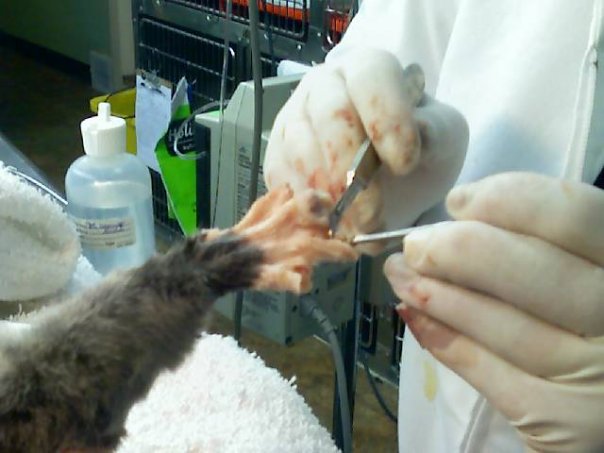
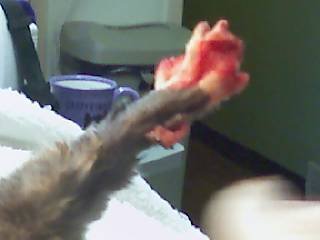
These photos were during her "re-declaw" surgery done to TRY and correct the problem.
From vet staff: "This cat was declawed (toe amputation) when she was a tiny kitten....her owner came in and said that she has cried every time - her whole life :( - that she jumps off of anything. She is 9 years old. She came in FINALLY when her paws started bleeding where she was declawed.....her bones were pushing through the skin. So painful and she was very scared and aggressive.
**********
“…San Francisco Care and Control ("some declawed cats become more nervous biters; others are known to become even more destructive to furniture than before the operation; and many cats stop using the litterbox"), East Bay SPCA ("deprived of their primary form of defense, declawed cats become nervous, fearful, and/or aggressive, often using their only remaining defense, their teeth. Some cats stop using their litter pan. This may be associated to the discomfort of scratching in the litter after the surgery"), and Palo Alto Humane Society ("we have a no-declaw policy"). These organizations and the individuals working there are obviously highly motivated to find each cat a home and do not wish to see the cat returned. They have found that declawed cats, with a disproportionate rate of biting and house soiling, have a relatively low adoption success rate.” Dr. Jennifer Conrad, DVM, The Paw Project,
**********
"Many cats find it painful to use the litter box, develop a conditioned aversion to using the box, and become un-housebroken. This is why many de-clawed cats are put up for adoption or are euthanized. They may also bite more, and become defensive when handled because their paws are hurting and infected... I have received a few letters from some cat owners who claim that their cats never developed any problems after being de-clawed. But have received many more letters to the contrary, so why run the risk? Dr. Michael W. Fox
http://www.twobitdog.com/
DrFox/specialreport_Article.aspx?ID=
46b4b2c4-93d6-4582-b4ec-7d311782aab8
**********
Unfortunately, some veterinarians are not aware of the consequences of this procedure...some think the cat will lose its home if they don't declaw it, but if you statistically analyze it, you realize that the cat has a higher chance of losing its home because of the subsequent behavioral changes," Conrad said, "It does not behoove the cat in any way.” Dr. Jennifer Conrad, DVM, "Supreme Court Upholds Ban On Declawing", Beverly Press, Vol. 17 No. 42, Oct 18, 2007
**********

Prevent unwanted animals in overcrowded shelters.
Their only crime is being born.
Their punishment is execution.
Please spay and neuter your pets.