WHAT IS DECLAWING?
Declawing is NOT a manicure. It is serious surgery. Your cat’s claw is not just a toenail. It is connected to the bone. To remove the claw, the last bone of your cat’s toe has to be removed as well as all of the blood vessels, nerves, tendons, and ligaments.
Declawing is an amputation of the last knuckle on each toe, cutting through bone, tendons, skin, and nerves. In a person, it is equivalent to amputating each finger or toe at the last joint. This surgery is the same for big cats.
For every bone amputation and piece of skin that is cut during declaw surgery, there is a wound site and opportunity for bleeding and hemorrhage.
The declawing procedure is described in detail by an actual eyewitness in The Declawing Procedure. This person is a vet tech in a veterinary clinic that performs the declawing procedure.
The video to the left shows animated declawing surgery.
The video on the right shows the actual surgical procedure.
Please notice: The veterinarian is using a tourniquet to keep the blood from shooting out of the severed blood vessels in the toe ends.
Also notice that all original sounds of the surgery have been removed because, even under heavy sedation, the cat screams each time the bone is cut and ripped from his paw.
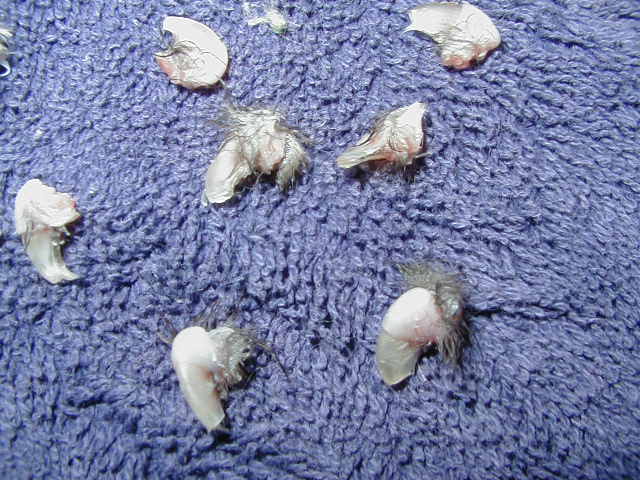
This picture shows the end result of declawing surgery. The claw and bone, including the first knuckle joint, are amputated and thrown away.
Notice the skin and hair still attached. Blood vessels, nerves, tendons, ligaments and skin are also affected by the bone amputations.
All of this is done to protect an inanimate object from being scratched. Think of the pain and suffering involved at the expense of the cat.
Want Your Cat to Hate You? Do This.
Written by Jeff Mackey / 07-19-2012
Dr. Narda Robinson, a university professor and veterinary educator, has come to the aid of animals in danger of mutilation from a surgery called "declawing."
In a new article published in Veterinary Practice News, she explains that even though the procedure involves 10 separate painful amputations at the last joint of a cat's toes, the willingness of many veterinarians to perform the cruel (but billable) operation makes cat guardians think, "Oh, it must be acceptable then," when it is not.
Dr. Robinson asks the following:
"How does protecting furniture or one's bottom line compare with the veterinarian's oath to employ knowledge and skill "for the benefit of society through the protection of animal health and welfare, the prevention and relief of animal suffering?"
Cats' claws and the bones and cartilage that hold them in place allow cats to balance properly, climb, and defend themselves. Declawing—which removes these claws, bones, and cartilage—is a terribly painful and permanently crippling procedure that can cause lasting nerve and other physical damage. Declawed cats have been known to resort to biting, and many have other permanent behavioral issues, including litterbox aversion—not to mention that if they somehow get outdoors, they don't stand a chance against predators.
There are effective and humane ways to prevent cats from inflicting damage with their claws, such as regular claw trimming and setting out numerous scratching posts and cardboard scratch pads.
For more information about declawing, please read the article "Is Declawing Cruel?" by David E. Hammett, DVM, and Suzanne Bucciarelli (DandyLions Cattery)
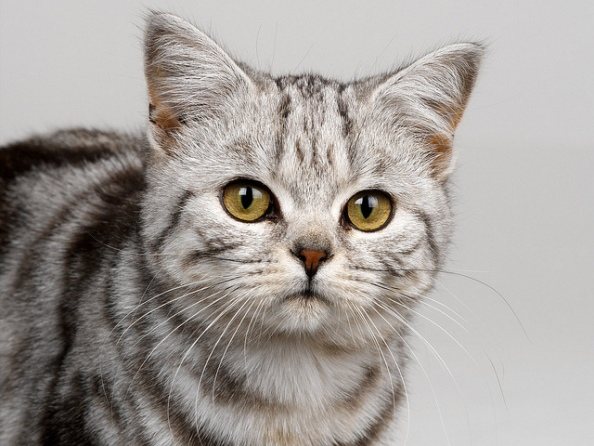
Cats claw to have fun and exercise, to maintain the condition of their nails, and to mark their territory.
kitty.green66|cc by 2.0
What You Can Do
If anyone you know is considering having a kitten or cat declawed, please make sure that the person has all the facts.
http://www.peta.org/b/thepetafiles/archive/2012/07/19/declawing-cats-violates-oath-says-vet.aspx
THE DECLAWING PROCEDURE in Human Terms
I'm All For Front Declaw - Take Two by Stumpy The Cat, Everywhere
A few days ago I read a post by a human-person from Canada who wrote that she was all in favour of front declaw. As a cat-person who knows about declawing I think she may be under a misapprehension. I’d like to make sure she knows what is involved before she makes her own appointment to be declawed.
Human-people have three knuckle joints on each finger, these knuckles are like hinges, they allow you to move your fingers with dexterity & they also allow you to work and to play. Cat-people are not so very different, although our hands, which we call paws, look different to yours, we also have three knuckles in our fingers, and we use them to look after ourselves too.
We use them to groom ourselves & to exercise ourselves by plugging into something and having a good stretch of all the muscles in our legs, chests, and backs. We also use our fingers and claws to defend ourselves against pretty much anyone who wants to have a go at us. But we differ slightly from human-people who can balance on only 2 feet, we cat-people have to walk on our hands and feet and we use our last joints of our toes to walk on, so you can see how important our toes are. This human-person isn’t in possession of all the facts. To make it quite clear and to save her from getting a big shock when she is declawed I have asked my human-person to help me illustrate declawing.
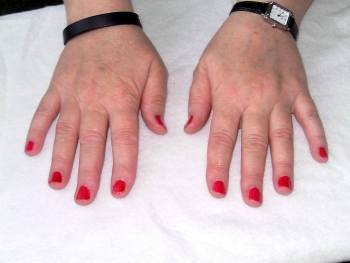
In the 1st picture do you see the perfection of the hand? The flexibility of the fingers is neatly covered in skin. Ideally that skin would never need to be wounded in any way, you wouldn’t imagine cutting into it unless it was for something extremely serious would you? You wouldn’t imagine cutting into such a work of art to sabotage the flexibility would you? Our paws are similar to your hands but as well as the skin we also have fur covering our perfect “hands”, and we have plump pads underneath to cushion our paws for when we walk up on our toes.
Hands, or paws, are miraculous aren’t they?
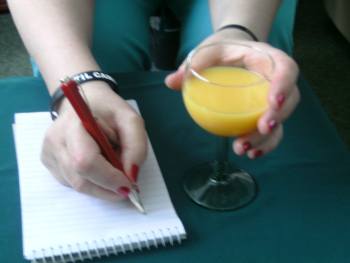
In the 2nd picture see what range of movement the human-person has, the right finger ends grip the pen, the other fingers fold neatly into the palm of the hand, while the left fingers hold the glass so it doesn’t fall over. And they lift it to the mouth for her to drink from the glass.
Cat-people's toes are also useful.
Some of us like to use our toes and claws to hook up chunks of food, some of the more unfortunate cat-people rely on their claws to catch foods to eat, though the ones who are really unfortunate are the ones who have been through this declawing procedure and then found themselves having to hunt for their own food. They have no hunting equipment and no defense weapons. They are doomed!
A human-person going to be declawed would have an advantage over a cat-person because she will know the reason why she is denied food and water the night before the op, cat-persons do not know this, they do not know what is going to happen to them until they are put in their basket and taken to the surgery where a nurse-person takes them from their human-person and put them in a cage. This Canadian-person will be put into a bed to await her surgery.
Shortly afterward an anesthetic-person (anesthesiologist) will come and she will be given things to make her sleepy, among the things given to cat-people might be Xylazine which can make us vomit. It can also make muscle tremors, seizures, slowed heart rate, and slowed breathing rate happen to us.
And even worse it says that despite appearing completely sedated, cats can still move, even kick, bite or scratch, in response to sharp auditory stimulation; frightening isn’t it? What about pain stimulation? Also we might be given Acepromazine which doesn’t always work if the patient is already excited and sometimes makes us aggressive.
And if that happens then sometimes Ketamine is used, that isn’t very nice as it gets sprayed into our mouths or eyes. It is a terrifying thing for cat-people to be treated like this because they do not understand. At least the Care-person will understand.
The anesthetic-person might also sick on her a pain relief patch, this is to relieve pain that she will not yet be feeling, but sticking it on pretty much confirms that there is going to be pain and that when that pain comes it will be too bad to wait for pain relief to be given then. Have you ever had a tooth out and felt the throb of something that isn’t there? That happens when limbs and digits are removed. Aren’t our bodies strange that we can feel pain, sometimes for years afterwards in parts of us that no longer exist? These are called phantom pains; sadly these pains are all too real and well proven to exist.
Ok then, the patient is now asleep and lying down although my human-person has not had the anesthetic of course. I would not ask that of her.
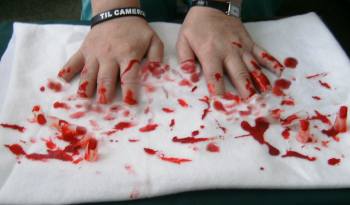
So, can you see in picture 3 what happens? Declawing isn’t declawing after all is it? It is de-finger-end-ing, the human-persons finger ends, along with her nails, have been amputated! They are lying there on the table quite separate to the rest of the finger. “Is this meant to be, or is this a big mistake?” you might ask, the answer would be no, it is no mistake THIS is what happens when you are declawed. Those very useful ends of our fingers are removed and thrown away!
Can you see all the blood? This is because the surgeon-person has used a scalpel to cut through all the bits inside that make the fingers work and through that perfect skin that encases and protects them. It is not always done like this. Sometimes the surgeon-person uses a strong, hot beam of light called a laser and burns through the fur, skin, cartilage, nerves, blood vessels, and bone to get the finger end off. Because they are burned the blood vessels are sealed off so they cannot bleed, but they are charred instead. And the result is the same; the end of the finger or toe is gone. Some people say this method is not cruel; I would like to ask them how so? Are the ends of our toes any less gone? No.
In this demonstration the human-persons finger ends were lopped off with a sharp scalpel so there is a lot, a hell of a lot, of blood. If you look at picture 4 you can see just how much blood there is on the bandages.
When this happens to cat-people, they wake up to the throbbing pain, in a cage, thirsty, sickly, needing the litter-box and scared.
They try to get away from the pain, not realizing that it is actually in their own paw.
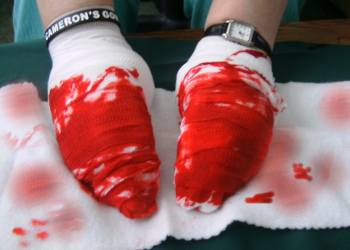
They throw themselves around the cage, and in doing so, they only make their poor paws bleed all the more. Many times they cause what is called hemorrhaging, and a lot of blood pours out through the bandages. If there is no nurse-person there to see this and to tend to the wounds, then the cat-person can so easily die.
Try to imagine bleeding to death after an operation that you didn’t even need or want.
This is beyond the comprehension of most people.
So, it is done. It is the work of maybe half an hour or so to remove the ends of our fingers but the effect is going to last us a lifetime. Human-people would find it hard to adapt to losing the tips of their fingers and so do cat-people. True enough we don’t write with pens or keyboards, or use combs or cutlery but imagine, if you will, having to use sore toe ends, or what has now become the ends of our toes, to clean up after ourselves in the litter-box. And imagine trying to stretch and instead of anchoring ourselves to something with claws now we find our paws slide down and get chafed and calloused because we cannot grip. You see, the stretching and scratching instinct is born in us, I think a lot of human-people think that we do it for badness but honestly we don’t, we just have to do it to keep ourselves fit. I’ve heard that not being able to do it means that when we get older we can have awful painful problems with our legs and hips and backs. Imagine trying to walk and finding out that you can’t walk as gracefully as you used to because your paws are different now, and imagine jumping, and falling.
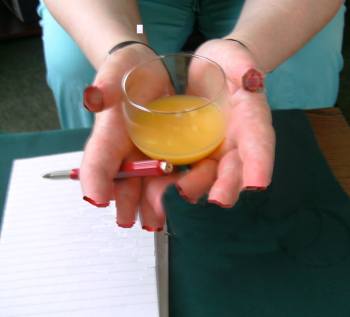
My human-person model has adapted as well as she has been able, if you look at picture 5 you will see that she is trying to hold the pen and the glass. I have no doubt that over the years left of her life she will find a way to manage as best she can, because after all she will have no choice.
And I think that this is what some blinkered human-people think about cat-people that have been declawed, they think that because they adapt and manage to live their lives that they are unaffected by the declawing procedure.
They could not be more wrong!
They do not realize that cat-people have millions of years of patience and stoicism behind them they are masters at making do and putting up with things.
BUT...
Cat-people do feel pain!
They do feel distress!
They do become depressed!
Sometimes in their pain and distress, because the cat-people cannot use their litter-boxes, human-people call them dirty and bad!
Having put the cat-people through the declawing procedure, the human-people still end up not wanting the cat-people and throw them out!
It is sad to us cat-people that we are so easily replaceable.
I hope you have found this letter useful and I hope the Canadian-person reads it and realizes what is involved. I think if she does she might not be for declawing after all. She might cancel her appointment to be declawed herself.
And if that is the case and she decides that she wouldn’t put herself through the declawing procedure then by rights she should never again put a cat-person through it either. Should she?
Nala - declawed cat
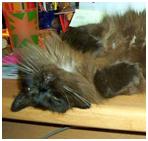
A vet tech who is painfully honest tells us that she can recognize the smell the blood of a declawed cat. She can recognizes the smell of a range of operations but declawing causes a lot of blood to flow and the cat tears at the bandages to open the horrible wounds. She also says that after the declaw operation, "I feel like the scum of the earth..."
This story concerns Nala, a Ragdoll cat. She is sheltered by Midwest Friends of Animals, Inc. Jasonville, IN, USA. I take the liberty of quoting verbatim from the vet tech's article as it is very poignant and informative. Could she come forward a leave a comment? She deserves a medal. I hope she is still in work.
Nala was declawed by her "owners". Her owners then didn't like Nala's behavior and relinquished her.
I don't know the name of the vet tech that provides this honest account on Petfinder.com but I feel an obligation to spread the story to inform people who simply are not aware of what they are doing.
The declaw operation is also described by this vet tech and it seems brutally quick.
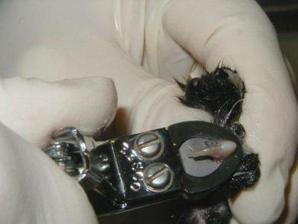
The procedure is sort of a half pull, half cut kind of thing. The nail clippers are doing their best to saw through the joint while the hemostats are ripping it away. And please make no mistake here, this isn't a nail trim. A cat's first joint, just like on your finger, is being ripped out. Nala utters a half growl/meow of pain as the joint tears away, even after all this medicine..."
The vet fills the gaping wound where the claws where with glue..."and squeezes it together for a few seconds...”
The day after the operation the vet tech has to re-bandage the wound and re-glue some of the mess.
"I drop some goo into Nala's socket and squeeze her tender and bruised deformed little toes together for several seconds. This hurts. A lot. And I feel like the scum of the earth...
Back to the shelter. Nala is not the girl she once was. The vet tech describes her condition far better than I could:
"She is very 'soured' on life in general and will also bite out of frustration, thanks to the owners who mutilated her and left her.
She has a safe and caring foster home and while we realize she will likely never be adopted and will have to live as a foster cat for her remaining years...
Do you want to put your cat through all that?
Please think again if you are considering declawing your cat. Don't take what the vet says as the truth. It isn't. It is biased. The truth is here on this page.
See the full story here: NALA (opens in a new window)
'Many vets and clinic staff deliberately misinform and mislead clients into believing that declawing removes only the claws in the hopes that clients are left with the impression that the procedure is a "minor" surgery comparable to spay/neuter procedures and certainly doesn't involve amputation (partial or complete) of the terminal-toe bone, ligaments and tendons. Some vets rationalize the above description by saying that since the claw and the third phalanx (terminal toe bone) are so firmly connected, they simply use the expression "the claw" to make it simpler for clients to "understand". Other vets are somewhat more honest and state that if they used the word "amputation", most clients would not have the surgery performed.
http://www.declawing.com/htmls/declawing.htm
**********
Unfortunately, some veterinarians are not aware of the consequences of this procedure...some think the cat will lose its home if they don't declaw it, but if you statistically analyze it, you realize that the cat has a higher chance of losing its home because of the subsequent behavioral changes," Conrad said, "It does not behoove the cat in any way.” Dr. Jennifer Conrad, DVM, "Supreme Court Upholds Ban On Declawing", Beverly Press, Vol. 17 No. 42, Oct 18, 2007
**********
From an Ontario animal shelter: "Many vets and people have argued that if they did not offer declaw surgery people would either surrender their pets to shelters or have them euthanized for unwanted scratching behavior. I believe that if declawing was not an option, the people who were that concerned about their furniture and belongings would not get a cat to begin with. Through the years, we have seen many declawed cats surrendered to our shelter for behavior issues that can be related to being declawed. Over the past two years, 75% of the declawed cats that were surrendered to us had behavioral problems. In that same time frame, only 4% of clawed cats were surrendered to us for the same behavioral reasons. I think those statistics speak for themselves. Studies show that declawing is a very painful procedure that can lead to long term issues, both physical and emotional.” From the Cats Anonymous Rescue & Adoption, spring 2010 Newsletter. They are a no kill shelter in Orton, Ontario that re-homes about 100 cats every year.
http://www.catsanonymous.ca/Newsletter%20-%20May%2015%202010.pdf

Prevent unwanted animals in overcrowded shelters.
Their only crime is being born.
Their punishment is execution.
Please spay and neuter your pets.