COMPLICATIONS
There are many complications associated with all surgeries. Most veterinarians don’t inform their clients about these complications, even though they do result in death or permanent disabilities.
"A declawed cat is anatomically and mentally damaged. Careful observation of clawed vs. declawed cats on entry to the vet’s office reveals a cat’s amazing ability to remember. They can and do associate cause and effect. This is a hallmark of a thinking sentient creature." Ron Gaskin DVM
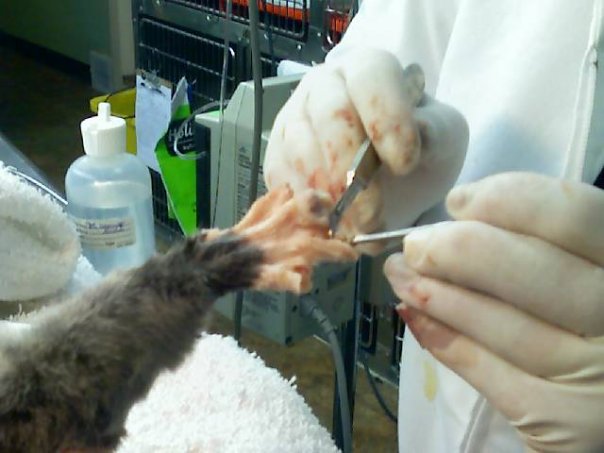
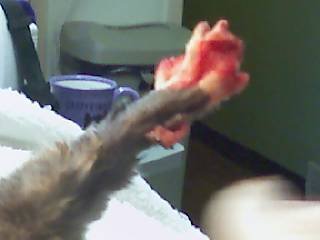
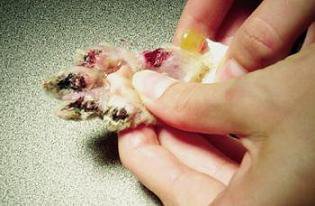
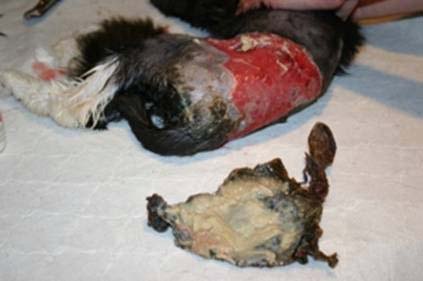
The complication pictures vets don't want us to see (see below)
'Many vets and clinic staff deliberately misinform and mislead clients into believing that declawing removes only the claws in the hopes that clients are left with the impression that the procedure is a "minor" surgery comparable to spay/neuter procedures and certainly doesn't involve amputation (partial or complete) of the terminal-toe bone, ligaments and tendons. Some vets rationalize the above description by saying that since the claw and the third phalanx (terminal toe bone) are so firmly connected, they simply use the expression "the claw" to make it simpler for clients to "understand". Other vets are somewhat more honest and state that if they used the word "amputation", most clients would not have the surgery performed!'
http://www.declawing.com/htmls/declawing.htm
By: Declawing CrippledmyPaws
PAIN
Many humans express pain in a variety of ways, many of which are verbal. Cats show pain in different ways than humans do. Cats are very stoic animals and prefer to hide their pain.
The procedure is sort of a half pull, half cut kind of thing. The nail clippers are doing their best to saw through the joint while the hemostats are ripping it away. And please make no mistake here, this isn't a nail trim. A cat's first joint, just like on your finger, is being ripped out. Nala utters a half growl/meow of pain as the joint tears away, even after all this medicine..."
http://www.pictures-of-cats.org/
the-smell-of-the-blood-of-a-declawed-cat.html
**********
"We may not know when some cats are suffering because of their stoic nature, and the fact that some cats in great discomfort may actually purr and seem to be half-asleep. Such self-comforting, so-called displacement behaviors are indicators of stress. Cats may learn to cope with the chronic pain of onychectomy, but the absence of overt pain does not mean they are pain-free." Dr. Michael W. Fox, D.Sc., Ph.D., B. Vet. Med., M.R.C.V.S.**********
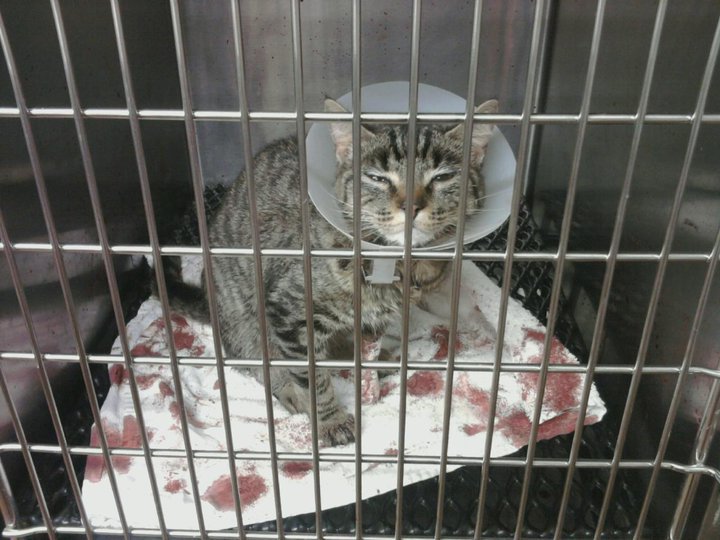
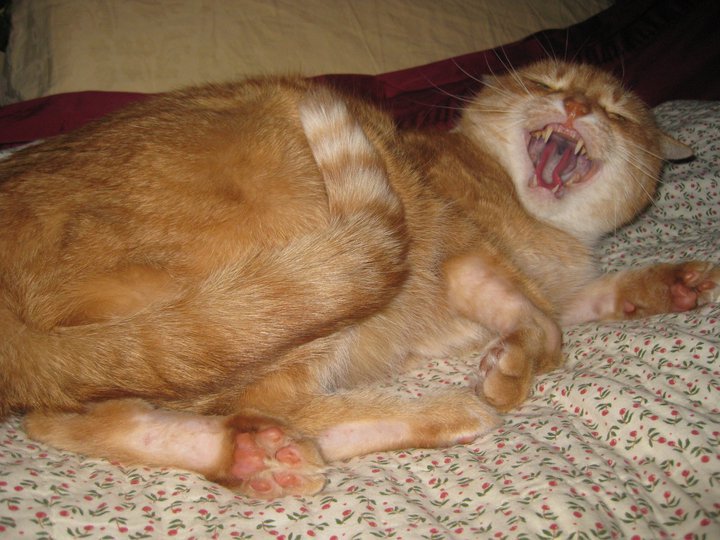
"Stoicism may be cats’ greatest enemy in the declaw debate. Nobody declaws dogs—in vet school we were told that it’s too painful. Dogs whine, scream, and howl; their pain is easy to recognize. But cats are quiet, and they characteristically endure pain without complaint. It is axiomatic in science that “lack of evidence does not equal evidence of lack.” With cats, a lack of obvious signs of pain does not mean the cat isn’t feeling pain; it may even be feeling a great deal of pain.
1. “Cats, due to their stoic nature, are notorious for not expressing pain and suffering.” (Benson GJ, Wheaton LF, Thurmon JC, et al. Postoperative catecholamine response to onychectomy in isoflurane-anesthetized cats: effect of analgesics. Vet Surg. 1991; 20(3):222-225.)
2. “…orthopedic procedures involving the fingers and toes of humans are associated with severe postoperative pain…” (Ibid.)
3. “Detection of pain in cats is a particular challenge, because signs of pain in cats are often subtle.” Cambridge AJ, Tobias KM, Newberry RC et al. Subjective and objective measurements of postoperative pain in cats. J Am Vet Med Assoc 2000; 217:685-690.
4. “Onychectomy is a painful procedure in cats… Unfortunately, cats typically receive analgesic medications for postoperative pain less often than do dogs.” (Romans CW, Gordon WJ, Robinson DA, et al. Effect of postoperative analgesic protocol on limb function following onychectomy in cats J Am Vet Med Assoc. 2005 Jul 1; 227(1):89-93.
5. Declawing is considered to be one of the most painful procedures an animal can undergo; regardless of method used, it is much more painful than spaying or neutering. Position statement on declawing. (American Association of Feline Practitioners. 2007 Nov. accessed 12/25/09)."
http://www.catvets.com/professionals/
guidelines/position/index.aspx?ID=291
Declawing and Science, Jean Hofve, DVM
http://www.littlebigcat.com/
health/declawing-and-science/
This 9 year old 4-paw declawed cat is in constant chronic pain and is currently on pain meds, joint support, and calming remedies. This cat was 4-paw declawed because her trusted vet told her human it would makes things "easier".
http://www.facebook.com/
photo.php?bid=169635886410516&set=a.
169635729743865.35039.
100000923166351
**********

"Virtually all human amputees report “phantom” sensations from the amputated part, ranging from merely strange to extremely painful (about 40% of such sensations are categorized as painful). Because declawing involves at least ten separate amputations, it is virtually certain that all declawed cats experience phantom pain in one or more toes. In humans, these sensations continue for life, even when the amputation took place in early childhood. There is no physiological reason that this would not be true for cats; their nervous systems are identical to ours. Cats are stoic creatures, and typically conceal pain or illness until it becomes overwhelming. With chronic pain, they simply learn to cope with it. Their behavior may appear “normal,” but a lack of overt signs of pain does not mean that they are pain-free". Dr Jean Hofve, DVM
http://www.littlebigcat.com/
health/declawing-a-rational-look/
**********
According to a pain management article from 2005, Dr. Gaynor, DVM states, "It is becoming more and more apparent that the number of feline patients who have declaw procedures performed have subsequent chronic pain issues...Another client complaint is a cat who just has some behavioral changes which may include decreased activity, decreased appetite, or increased aggression...within days to months to years..."
http://www.cvmbs.colostate.edu/
ivapm/professionals/members/newsletters/IVAPM%20May%202005.pdf
**********
"Many cats find it painful to use the litter box, develop a conditioned aversion to using the box, and become un-housebroken. This is why many de-clawed cats are put up for adoption or are euthanized. They may also bite more, and become defensive when handled because their paws are hurting and infected... I have received a few letters from some cat owners who claim that their cats never developed any problems after being de-clawed. But have received many more letters to the contrary, so why run the risk? Dr. Michael W. Fox
http://www.twobitdog.com/DrFox/
specialreport_Article.aspx?ID=46b4b2c4-93d6-4582-b4ec-7d311782aab8
**********

STELLA HAS NO FEET!
"In 2004, so I am told, her past “owners” brought her to a Vet and had her de-clawed because she was scratching her head repeatedly behind her ears and they were worried she was hurting herself. That was the day that Stella, then named Molly, said good bye to her claws in what should have been a routine yet needless operation. Stella’s rehab did not go well and within days both rear feet had become so infected that they had to be removed."
http://www.stellahasnofeet.com/
whois.html
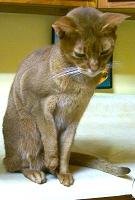
"This declawed Abyssinian cat (left) shows 4 distinct signs of pain: (1) half-closed eyes, (2) pulled-back whiskers, (3) holding the right front foot up, and (4) placing the left front foot over the edge of the counter so there’s as little weight on his painful toes as possible."
http://www.littlebigcat.com/
health/declawing-a-rational-look/
**********
"In declawed (and tendonectomized) cats, the tendons that control the toe joints retract after surgery, and these joints become essentially “frozen.” The toes remain fully contracted for the life of the cat. In cats that were declawed many years ago, the toe joints are often so arthritic that they cannot be moved, even under deep anesthesia. The fact that most cats continue to make scratching motions after they are declawed is often said to “prove” that they do not “miss” their claws. However, this behavior is equally well–and more realistically–explained as desperate but ineffective efforts to stretch those stiff toes, legs, shoulders, and backs.” Dr. Jean Hofve
http://www.littlebigcat.com/
health/declawing-a-rational-look/
**********


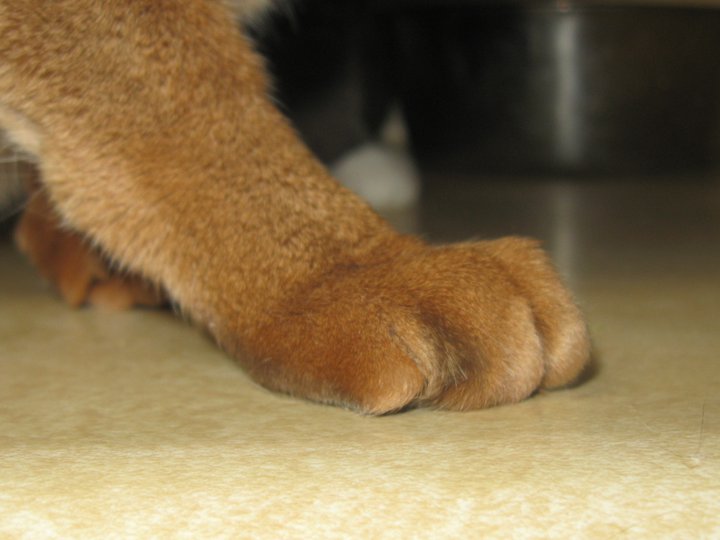
"...Raven before her declaw repair surgery. Dr. Gaskin said, "Notice the position of the knuckles of her front feet. This position puts her amputated toes on the hard surface first."
To the left is Raven's radiograph which "illustrates the extreme acute angle between phalange 2 and phalange 1. Also notice the foamy look on the end of phalange 2 on digits 2 & 3 (major weight bearing digits). This foamy look is chronic damage to the cartilage & bone end from walking on the amputated toe tips."
http://www.pictures-of-cats.org/
dr-ron-gaskin-is-a-good-vet-who-
performs-declaw-repair-surgeries.html
"De-clawed cats tend to walk abnormally back on their heels rather than on their entire pads because of the chronic pain at the end of their severed fingers and toes. They often develop chronic arthritis and as the front toe pads shrink, chronic bone infections are common....The tendons that control the toe joints retract after surgery. These joints essentially become “frozen.” The toes remain fully contracted for the life of the cat. In order to keep weight off the tender amputated toes, cats shift their weight backward, the altered gait stressing the limbs and spine, which could lead to arthritis later in life.” Dr. Michael Fox
http://www.twobitdog.com/
DrFox/specialreport_Article.
aspx?ID=46b4b2c4-93d6-4582-b
4ec-7d311782aab8
**********


"Facts about declawing: Declawing the cat causes hyperflexion of the phalanges I and II. This leads to the cat walking on its digit 2 & 3 bone ends. These cats are very painful. Digital dental x-rays of the front digits show the pathology and painful changes in black and white. They bite and act out a painful creature. Litter box problems are very common as the litter hurts their feet more. Obesity and activity exacerbate the problem. Anatomically; the deep digit flexor tendon on phalange II is unopposed by any extensor tendon. Vets are NOT trained to look for these changes in a declawed cat. Many declawed cats in pain go misdiagnosed as "behavioral problems". A very few vets know how to relieve the pain with surgery. Saying that declawing will keep the cat a good home is an oxymoron and emotional black mail. Do not declaw your cat!"
http://www.pictures-of-cats.org/
dr-ron-gaskin-is-a-good-vet-who-
performs-declaw-repair-surgeries.html
**********
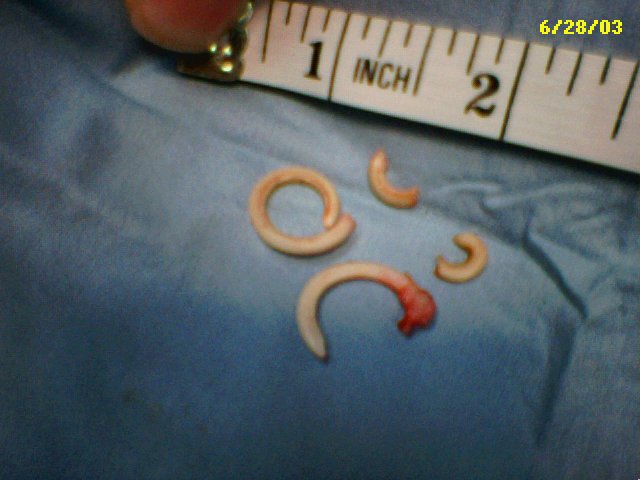
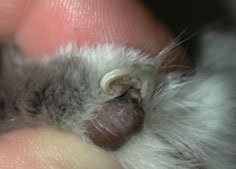
"The claw in the picture, which was originally in one piece before surgery, was removed from inside the paw of a 10 year old cat. The cat had been declawed as a kitten and what you see is the regrowth that occurred. This was discovered when, during a recent routine examination, the vet felt something odd in the cat's front paw. The poor cat spent years living with this problem unnoticed and it was undoubtedly painful. This is just one of the many complications that can and do occur when a cat is declawed.
**********

"...Declawing that results in biting or inappropriate elimination outside the litterbox may result in the cat being permanently locked in the basement, dumped at a shelter, or simply abandoned. Many cats are exiled to a life outdoors because of these unwanted behaviors. There, they also risk injury or death by dogs, cars, wild predators, disease, poison, and other hazards of outdoor life; even more so than clawed cats who retain their primary defenses. People who work with feral cat Trap-Neuter-Release programs often find declawed cats in their traps--cats that should never have been outside at all. These cats once had homes, but were abandoned in an alley or field--almost certainly due to behavior problems resulting from declaw surgery. The claim by veterinarians that "declawing keeps cats in their homes" clearly isn't true for these declawed cats that lost their homes and were abandoned to an uncertain fate. There is no way to know how many cats are dumped this way, but based on experiences in Denver, a typical urban environment, the number is likely in the many thousands. "Declawing: A Rational Look" Dr. Jean Hofve, DVM
http://www.littlebigcat.com/
index.php?action=library&act=show&item=002
**********
... (declaw surgery)..."I've counseled too many cases when these cats becoming biters and/or develop litter box problems due to painful paws" Amy D. Shojai, IAABC Certified Animal Behavior Consultant
http://www.heralddemocrat.com/
articles/2007/08/29/life/life04.txt
**********
Unfortunately, some veterinarians are not aware of the consequences of this procedure...some think the cat will lose its home if they don't declaw it, but if you statistically analyze it, you realize that the cat has a higher chance of losing its home because of the subsequent behavioral changes," Conrad said, "It does not behoove the cat in any way.” Dr. Jennifer Conrad, DVM, "Supreme Court Upholds Ban On Declawing", Beverly Press, Vol. 17 No. 42, Oct 18, 2007
**********
From an Ontario animal shelter: "Many vets and people have argued that if they did not offer declaw surgery people would either surrender their pets to shelters or have them euthanized for unwanted scratching behavior. I believe that if declawing was not an option, the people who were that concerned about their furniture and belongings would not get a cat to begin with. Through the years, we have seen many declawed cats surrendered to our shelter for behavior issues that can be related to being declawed. Over the past two years, 75% of the declawed cats that were surrendered to us had behavioral problems. In that same time frame, only 4% of clawed cats were surrendered to us for the same behavioral reasons. I think those statistics speak for themselves. Studies show that declawing is a very painful procedure that can lead to long term issues, both physical and emotional.” From the Cats Anonymous Rescue & Adoption, spring 2010 Newsletter. They are a no kill shelter in Orton, Ontario that re-homes about 100 cats every year.
http://www.catsanonymous.ca/Newsletter%20-%20May%2015%202010.pdf
**********


From vet staff:
"This cat was declawed (toe amputation) when she was a tiny kitten....her owner came in and said that she has cried every time - her whole life :( - that she jumps off of anything. She is 9 years old. She came in FINALLY when her paws started bleeding where she was declawed.....her bones were pushing through the skin. So painful and she was very scared and aggressive. These photos were during her "re-declaw" surgery done to TRY and correct the problem.
**********
Working for a vet that declaws, a vet tech says she hates the procedure but feels she can do more good by ensuring the welfare of her patients by being there on the spot, and she can also help educate people as to the cruelty of declawing.
She says:
'Even with our supposedly superior methods of pain control, we still routinely have declawed cats tearing off their bandages and thrashing in pain upon awakening from the operation. It was the sheer amount of pain control medication that we give these cats that first clued me in to how truly odious this procedure is.
‘Typical pain control protocol for a declaw at the clinic where I work includes both pre- and post-operative injections, nerve-block injections in the paws, oral meloxicam to go home with, and the application of a transdermal fentanyl patch- this last of which is such a strong opiod-based painkiller that, when used in human medicine, I have heard it is typically only prescribed for the terminally ill’
This demonstrates just how much agony cats suffer from declawing and we already know that some vets not only declaw, but give clients the choice of pain medication by paying extra ! The thought of how many cats are suffering from this senseless abuse is heart breaking.
BLEEDING
All surgeries that break the skin cause bleeding. When declawing a cat, there are ten (front paw declaw) or eighteen (4-paw declaw) separate surgeries. Each surgical site cut through skin, bone, tendons, blood vessels, etc, which results in bleeding. The use of a tourniquet only stops the blood flow long enough for the surgeries to be completed on one foot. After the tourniquet is removed, the blood flow to the foot resumes, which causes unhealed wounds to bleed. Even with stitches, there is still blood flow to the wounds which can bleed profusely.
"His routine de-clawing turned into a nightmare when his vet removed the stitches, Connelly reported. "The cat was squirting blood," Heise said. She watched in horror as the vet yanked out her cat's stitches. "Without gloves -- without washing his hands -- without any instruments, he took and he ripped the cat's sutures out with his fingernails...The second veterinarian saved Samson's paws and possibly his life. According to Heise, "it was a bad situation. The infection had spread into his blood and into his soft tissue."
http://www.10tv.com/?sec=news&story=
sites%2F10tv%2Fcontent%2Fpool%2F200801%2F1696740312.html
**********
"Monkey was released with bleeding front paws. There were large areas of tissue missing and the pads were either cut or missing."
http://www.cleveland.com/
living/plaindealer/index.ssf?%2Fbase%2Fliving-0%
2F1200216641105730.xml&coll=2
**********
"A friend had her indoor cat declawed even though she was reluctant to do so. It was a terrible experience for both the cat and the family. The poor cat bled profusely, made bloody footprints on the floor, slinging blood onto the wall. Now her paws are infected and the vet is keeping her.
http://blogs.chron.com/
animalqa/2009/07/are_postdeclawing_infections_c.html
**********
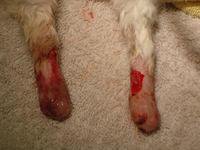
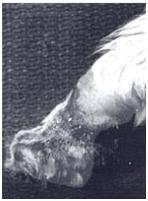
"The photo on the right shows complications from declawing a 6-week old kitten. Because she kept bleeding after surgery, bandages were applied; they were too tight. Subsequently, the skin on her lower legs and feet as well as paw pads became necrotic (dead) and sloughed off."
http://www.littlebigcat.com/
health/declawing-a-rational-look/
**********

BURNS
Lasers use light to burn through flesh and bone. It is very unlikely that the veterinarians who perform laser declaw surgery practice these precautions described by Taber.
“Laser is an acronym for Light Amplification by Stimulated Emission of Radiation. A laser is a device that emits intense heat and power at close range. The instrument converts various frequencies of light into one small and extremely intense unified beam of a single frequency or wavelength radiation. The laser can be focused on a very small target…
“CAUTION: Laser safety precautions must be observed. For example, warning signs should be posted indicating that a laser is being used… skin preparation solution may not contain combustible agents; and towels draped around the site must be kept wet. The laser equipment must be moved carefully, to avoid jarring the mirrors out of alignment. Alcohol-based skin preparations should not be used.”
Taber’s Cyclopedic Medical Dictionary, Edition 20
**********
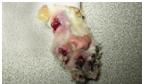
BURNS FROM LASER DECLAW SURGERY.
"Declawing, when performed by laser, is still the amputation of the last toe bone of the cat and carries with it the same long-term risks of lameness and behavioral problems as does declawing with scalpels or clippers. Studies have failed to show that laser declawing is less painful for the cat in the post-operative period.” Humane Society Veterinary Medical Assoc Cosmetic & Convenience Surgeries Position Statements
**********
"I had Roscoe and Jaspurr laser declawed about two months ago and it has been nothing but pain and suffering for them. I chose to do it with the laser because the vet said 'it was less bleeding, less painful, and less swelling.’ What she did not tell me is about all the complications that go along with the surgery.” Lisa Violet's Declaw Horror Stories
**********
"Complications (bleeding, limping, swelling, infection) were generally worse in the laser onychectomy group in the first 2 days after surgery but were equivalent thereafter.” My Vet Said Laser Was Better, Dr. Jennifer Conrad, DVM, The Paw Project
**********
"...she jerked her body, meowed at me twice while looking into my eyes and then she died. Laser Surgery was not better...the decision to get her declawed is the worst decision I have ever made; it took a life, my Tazzy's life. I will not be able to get past this, what I have done; the torture my baby went through. Cat Dies from Infection After Laser Declaw Surgery
**********
"No matter how the claws are removed, a cat without claws is missing part of his toes and has to go through life without being able to perform one of the most enjoyable and beneficial parts of being a cat: scratching - with claws. The whole basis of scratching, the aspect that provides the refreshing workout and exercise, is pulling against the resistance of dug-in claws". Gary Lowenthal, author of "Why Cats Need Claws" from Is Laser Declaw Better?
NECROTIC TISSUE
Declawing can cause necrotic, or dead, tissue on the cat’s legs and feet. Necrotic tissue can also be the result of wounds that become infected.
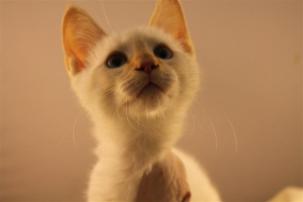
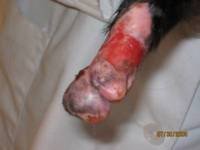
DECLAWING COST THIS 6-MONTH-OLD KITTEN HIS LEG!! He was turned in to the Greenville County animal shelter by its owners because they couldn’t afford the surgery to amputate the kittens leg- the kitten was declawed a couple of weeks ago and one of its feet got infected… treatment was not possible- the tissue in the leg was dead- so the whole leg was amputated.
http://www.facebook.com/photo.php?
fbid=327966360614966&set=a.323758537702415
.74873.194011810677089&type=1&theater
fbid=327966360614966&
.74873.19
DECLAWING ROBS CATS OF THEIR MAIN MEANS OF SELF DEFENSE
"...She is declawed and stayed out overnight about three weeks ago. The family found her the next morning-she had been attacked by an animal. They brought her to the vet and her back wounds were cleaned and dressed and she was given antibiotics. Two weeks later the wound remained grossly infected and became necrotic. The family was given a $4,000 or greater estimate to surgically debride and graft her back. That is when the cat came to AG. The family could not afford the expense..."
http://www.handicappedpets.com/
Articles/declaw/index.html
**********
Necrotic (dead) tissue 2 weeks after declaw surgery on a 3 year old cat.

**********
Necrotic/dead soft tissue

"The photo below shows complications from declawing a 6-week old kitten. Because she kept bleeding after surgery, bandages were applied; they were too tight. Subsequently, the skin on her lower legs and feet as well as paw pads became necrotic (dead) and sloughed off."
http://www.littlebigcat.com/health/
declawing-a-rational-look/

Necrosis of soft tissue following onychectomy
Picture courtesy of College of Veterinary Medicine, Ohio State University
http://maxshouse.com/
facts_about_declawing.htm
ULCERS
One of the complications of declaw surgery is the ulcerated paw pads. These ulcers develop because the cat has to walk and stand on his wrists. This abnormal stance results in improper pressure on the pads which causes rubbing, blisters, and eventually ulcers.
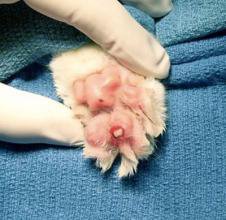
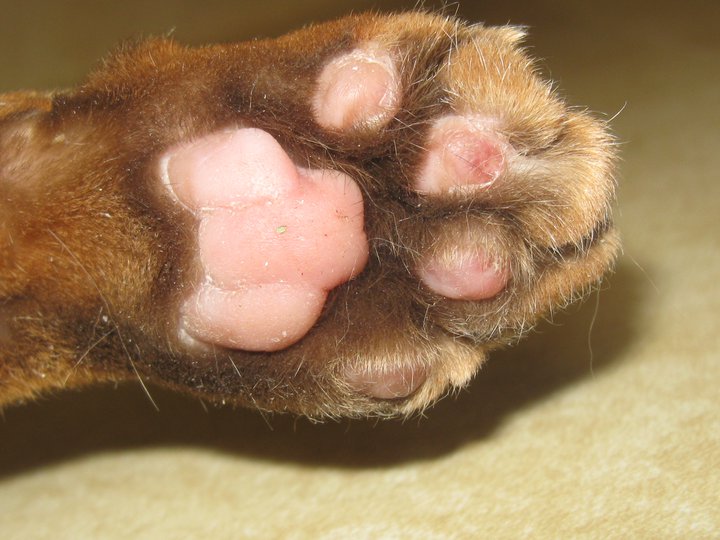
CLAW REGROWTH
Regrowth of claws is the result of an inadequate amputation of the third phalanx of the first digit of each toe. If left untreated, the claw will continue to grow, cause constant pain, and possibly break through the skin.
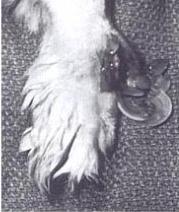
Regrowth of claws associated with inadequate amputation of the third phalanx of the first digit.
Picture courtesy of College of Veterinary Medicine, Ohio State University

Abnormal claw growth that has protruded through the skin.
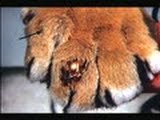
"Abnormal nail regrowth. The declaw procedure left portions of the nail-forming tissue, resulting in the grossly abnormal claw shown in this picture."
http://www.pawproject.com/
html/cases.asp?SortOrder=7


"The claw in the picture, which was originally in one piece before surgery, was removed from inside the paw of a 10 year old cat. The cat had been declawed as a kitten and what you see is the regrowth that occurred. This was discovered when, during a recent routine examination, the vet felt something odd in the cat's front paw. The poor cat spent years living with this problem unnoticed and it was undoubtedly painful. This is just one of the many complications that can and do occur when a cat is declawed.
DEFORMITIES
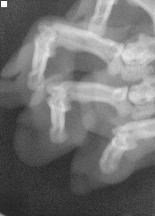
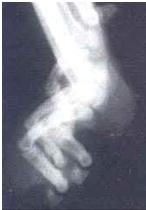
These x-rays are medical proof of the damage caused by declawing!
X-rays don't lie, but most caretakers of declawed cats are in complete denial that "de-clawing" has caused any joint and skeletal damage and inflammation.
"A declawed cat is anatomically and mentally damaged. Careful observation of clawed vs. declawed cats on entry to the vet’s office reveals a cat’s amazing ability to remember. They can and do associate cause and effect. This is a hallmark of a thinking sentient creature." Ron Gaskin DVM In a study published in the January, 2001 JAVMA, 33% of 39 (1 in 3) cats that underwent onychectomy (declawing) developed "at least" one behavior problem immediately after surgery, with the most common problems being litter box problems and biting.
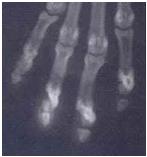
"To the right is Raven's radiograph which illustrates the extreme acute angle between phalange 2 and phalange 1. Also notice the foamy look on the end of phalange 2 on digits 2 & 3 (major weight bearing digits). This foamy look is chronic damage to the cartilage & bone end from walking on the amputated toe tips.” Dr. Gaskin said, "Notice the position of the knuckles of her front feet. This position puts her amputated toes on the hard surface first."
http://www.pictures-of-cats.org/
dr-ron-gaskin-is-a-good-vet-who-
performs-declaw-repair-surgeries.html

Radiograph depicting inadequate amputation of the third phalanx in a cat with regrowth of claws following onychectomy. When there is evidence of regrowth at one site, it is common to find an excessive amount of the third phalanx remaining at additional sites.
http://www.facebook.com/
l.php?u=http%3A%2F%2Fmaxshouse.com%2Ffacts_about_declawing.htm&h=34de0
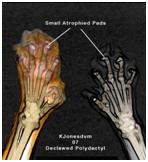
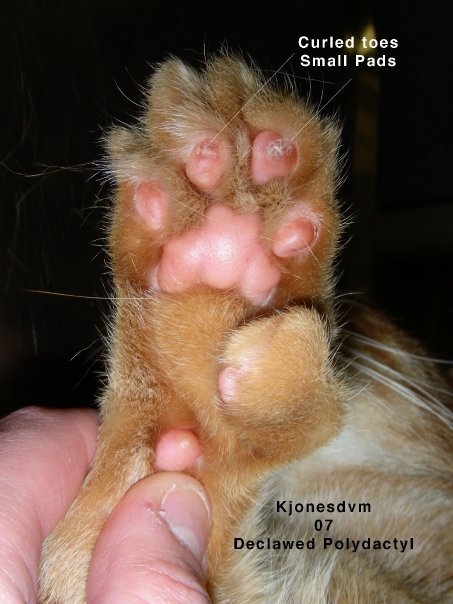
Here are some photographs and an x-ray showing the damage caused by declawing, courtesy of Ken Jones, DVM photos. Dr. Jones does not declaw cats, but repairs and rehabilitates declawed cats.


"Facts about declawing: Declawing the cat causes hyperflexion of the phalanges I and II. This leads to the cat walking on its digit 2 & 3 bone ends. These cats are very painful. Digital dental x-rays of the front digits show the pathology and painful changes in black and white. They bite and act out a painful creature. Litter box problems are very common as the litter hurts their feet more. Obesity and activity exacerbate the problem. Anatomically; the deep digit flexor tendon on phalange II is unopposed by any extensor tendon. Vets are NOT trained to look for these changes in a declawed cat. Many declawed cats in pain go misdiagnosed as "behavioral problems". A very few vets know how to relieve the pain with surgery. Saying that declawing will keep the cat a good home is an oxymoron and emotional black mail. Do not declaw your cat!"
http://www.pictures-of-cats.org/
dr-ron-gaskin-is-a-good-vet-who-
performs-declaw-repair-surgeries.html

Radiograph depicting inadequate amputation of the third phalanx in a cat with regrowth of claws following onychectomy. When there is evidence of regrowth at one site, it is common to find an excessive amount of the third phalanx remaining at additional sites.
http://www.facebook.com/
l.php?u=http%3A%2F%2Fmaxshouse.com%2Ffacts_about_declawing.htm&h=34de0

DEATH

"I have done the most horrible thing in my life and I am suffering everyday and every day I will be haunted for what I have done. My 13 1/2 year old Tazzy was a beautiful cat, my husband and I got her when she was a kitten. She was older than our children and was like a daughter to us. I trimmed her nails every Monday. She scratched things in our house but to me now all those "things" don't matter. We just moved into a new house last year and got all new furniture. I kept her nails trimmed but for some reason she seemed to get holes in the new couch, so tiny but I saw them. I then seemed to put my furniture at priority because I called a vet and asked them about declawing.
"I said she is 13, is she too old? Thinking they would say yes, of course, but they said, "no, we do this all the time for older people who are taking their cats to a nursing home and have to have the cats declawed." I hung up and called 3 more vets, they said the same thing. One even told me about the new Laser declaw, I had never heard of it, they said it was less painful, fast recovery time, etc. I then talked to my husband, and we decided to spend the extra to get the Laser.
"We took Tazzy in on November 2nd, 2008 and left her at the vet's to be declawed. I was told to bring her in the morning no food past 6 pm the past day, but by 3:30 pm she still was not in surgery. I was worried she was hungry. They got her in surgery and called to say everything went well, and I could pick her up in the morning. She looked the same, was eating as soon as I got her home, no bandages on her feet. I used the special litter in the big litter box that Tazzy and my other cat shared. I thought I would just keep an eye on Tazzy's paws.
"Now fast forward to Nov 20th: That night Tazzy slept in my son's bed, he told me something wet was on her and turned on the lights. Her paw was bleeding. I cleaned it and everything up, and the next morning called the vet. My husband took her to the vet. He said they cleaned her paw, said we need to use the right litter, and never mentioned weight loss or an infection. Also her meow was so low, almost gone, but they said that was from the tube from the surgery being down her throat. This was 19 days after the surgery, but I believed them. They bandaged her paw up; she had the bandage off within 1 day.
"Within the next few days, I was questioning if she was eating. I saw her by the water bowl every day, and she seemed to be herself, sleeping in the sun, in my son's bed, using the litterbox. My son said he saw her eat the one day, but I said I haven't. I would hear her going down the stairs at night and figured she was eating. Then there was two times my husband and I found her in our bathtubs, she for some reason was laying in them.
"Her breath got really stinky, and she looked so bad. We saw that her thumb paw was big, this is the first time I seen the swelling. I had been looking at her paws, but the thumb paw I must have not looked at it, just the four fingers. I saw it was big and saw a little hard piece of something and pulled at it. (I don't know if was glue or litter) Then a big blood rush came out, black blood. I flipped out! Then blood clots came out, and I was so scared. I kissed her, called the vet, and asked can I bring her right now? I took her in, and they said she had a bad infection. They got the pills, and I said can you give her an injection? They said yes, and they kept her all day and gave her fluids and force fed her.
"I picked her up that evening which was Nov 26th Wednesday. They wanted to keep her over night, but with Thanksgiving, they couldn't. So they told me to force feed her. She looked so much healthier that day and the next. We fed her every 4 hours, and on Friday, we were taking her in again for a checkup. I told them she had diarrhea. They gave me medicine for it and said she looked so much better.
"Then that Friday night, it seemed a little harder for us to feed her, and by Saturday, even harder. I then gave her the meds for diarrhea on Saturday. Saturday night she looked so bad again, just like before, that we knew she was going to die. Sunday morning I got up and checked on her. She was sleeping. Ten minutes later, I went over and picked her up and called to my husband. My other cat came over sniffed her and then starting howling. Within minutes she jerked her body, meowed at me twice while looking into my eyes, and then she died.
"It’s been over 3 months, and I am so much worse off than I was before! I am dreaming of her. I have so much guilt for what I have done. I lost my baby! She would have been 14 this April. She was still playful. She loved us. She counted on us to take care of her, and I let her down, over some stupid furniture that now I have been wanting to burn!
"Material things are nothing!
"My cat was my life, and I took her for granted!
"Laser Surgery was not better!
"Yes, I made mistakes, not seeing the signs. That is part of my guilt, but the decision to get her declawed is the worst decision I have ever made. It took a life, my Tazzy's life!
"I will not be able to get past this, what I have done; the torture my baby went through.
"DON'T EVER DECLAW!
"I would do anything to have her damaging my couches right now. I would let her tear my house down to have her right now!
I hate myself for what I have done!
"Learn from my story: PLEASE REMEMBER MY STORY FOR OTHERS."
http://declawhallofshame.com/

Prevent unwanted animals in overcrowded shelters.
Their only crime is being born.
Their punishment is execution.
Please spay and neuter your pets.